
Testosterone care built on a diagnosis — not a number.
Endocrinologist-led evaluation and treatment of low testosterone — the symptoms, the laboratory work, the underlying cause, fertility, and the real benefits and real risks of treatment. TRT should be the result of a diagnosis, not the diagnosis itself.
Men arrive at this question from very different places.
Find the one that sounds like you. Each goes to the chapter that answers it, not to a symptom quiz.
I have symptoms and I have never been tested.
Fatigue, low libido, poor concentration, declining strength. Start by understanding how nonspecific these are — and what else causes them.
I have a number and I do not know what it means.
340? 280? Was it a morning sample? Was it fasting? Was it repeated? A single result is wrong about 30% of the time.
I have been offered testosterone and I am deciding.
Ten steps to work through, and ten questions to take into the appointment.
I am on testosterone and something has come up.
Rising hematocrit. A PSA change. A partner who wants children.
We are trying to conceive.
Testosterone therapy suppresses sperm production. This conversation should happen before the first dose, not after.
I want to raise it without medication.
Weight, sleep, alcohol, training and the supplement aisle — graded honestly, including what does nothing.
I want to know what the evidence actually says.
What TRAVERSE showed, what it did not, and where the major societies openly disagree.
My partner has been offered testosterone.
One indication has good randomised evidence. No product is FDA-approved. And gel transfer is a household issue.
Or start at the beginning: what testosterone actually does →
Hormones are our specialty.
The difference between a testosterone clinic and an endocrine practice is not the prescription pad. It is what happens before it comes out.
| Testosterone-focused clinic | Endocrine-led care | |
|---|---|---|
| Primary goal | Raise the number | Find out why it is low, then decide whether raising it helps |
| Front door | A symptom quiz | A history, an examination, and a repeated morning sample |
| LH and FSH | Often skipped | Measured before treatment, because afterwards they tell you nothing |
| Fertility | Raised after the first dose, if at all | Settled before it |
| Thyroid, diabetes, metabolic health | Referred elsewhere | Managed by the same physician, in the same plan |
| Time horizon | The next refill | The next thirty years |
Listen. Test. Treat.
The complaints that send most men to have their testosterone checked — fatigue, low mood, poor concentration — are, on the best population evidence, not the ones that track testosterone. That is precisely why the history matters more, not less. An unhurried consultation, and symptoms taken seriously rather than scored on a quiz.
Early morning, fasting, on a validated assay, and repeated before anything is decided — around 30% of initially low results are normal the second time. Then LH and FSH to locate the problem, and a search for the cause: weight, sleep, medication, alcohol, thyroid, prolactin, chronic illness. A good share of low testosterone is reversible without a prescription.
When treatment is right, it is individualized, monitored, and reviewed against what it was supposed to fix. When it is not right, we say so — including when the honest answer is to treat something else entirely.
TRT, done properly: indicated, individualized, monitored.
Testosterone is medicine. It has real benefits, real risks, and a real monitoring schedule — and it is the wrong answer more often than the market admits.
Every formulation, compared
Injectables, gels, patches, nasal, pellets and oral — what each is good and bad at, and what the label actually warns about.
When it is the wrong answer
Sleep apnea, opioids, alcohol, severe energy deficit, thyroid disease, prolactinoma. Treating the cause beats treating the hormone.
The prostate and the heart
What TRAVERSE settled, what it did not, and the two findings that usually get left out of the summary.
Physician-scientists. Board-certified endocrinologists. Your doctors.
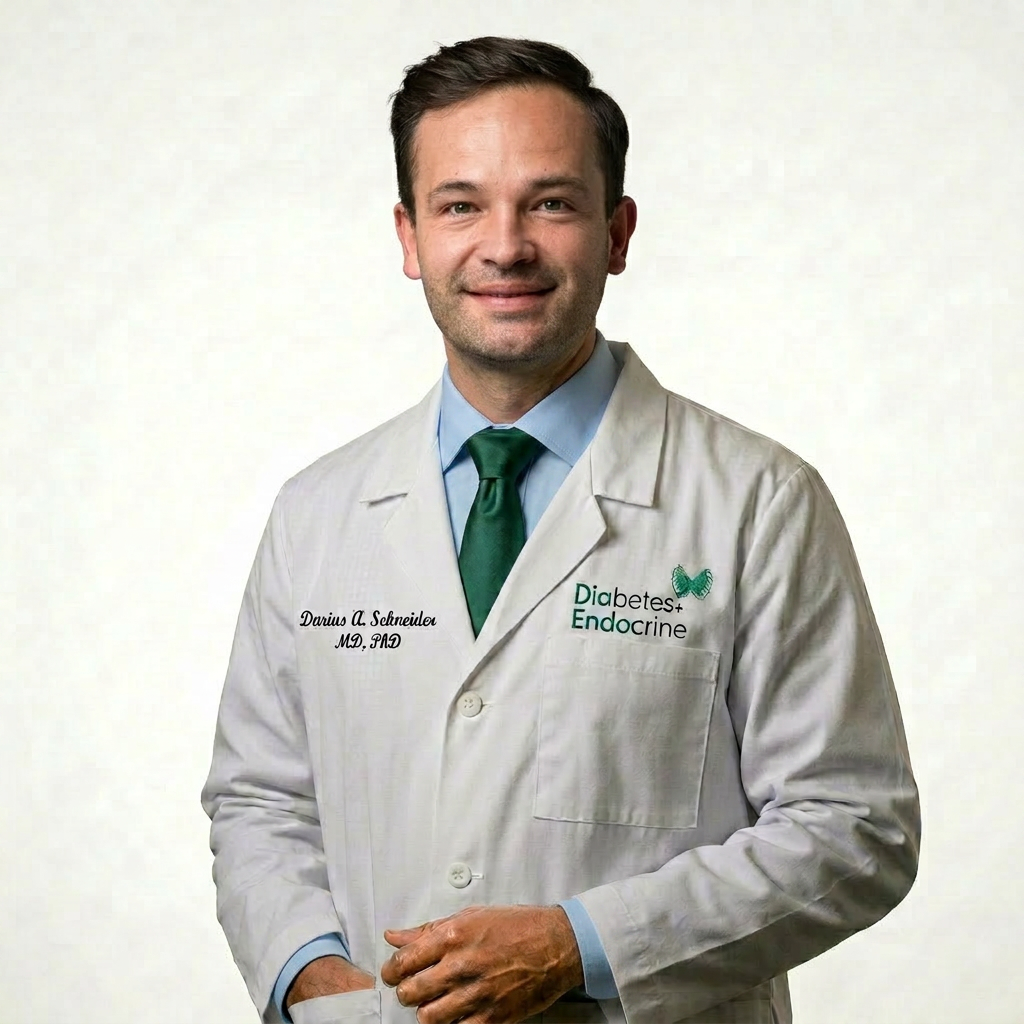
Darius A. Schneider, MD, PhD
Board-Certified Endocrinologist · ECNU · Owner & President
Endocrinologist, and owner and president of Diabetes and Endocrine Specialists Medical Group. Low testosterone, testosterone replacement, male infertility and gynecomastia are part of the practice's men's health service line. Every page on this site is written and signed by a physician.
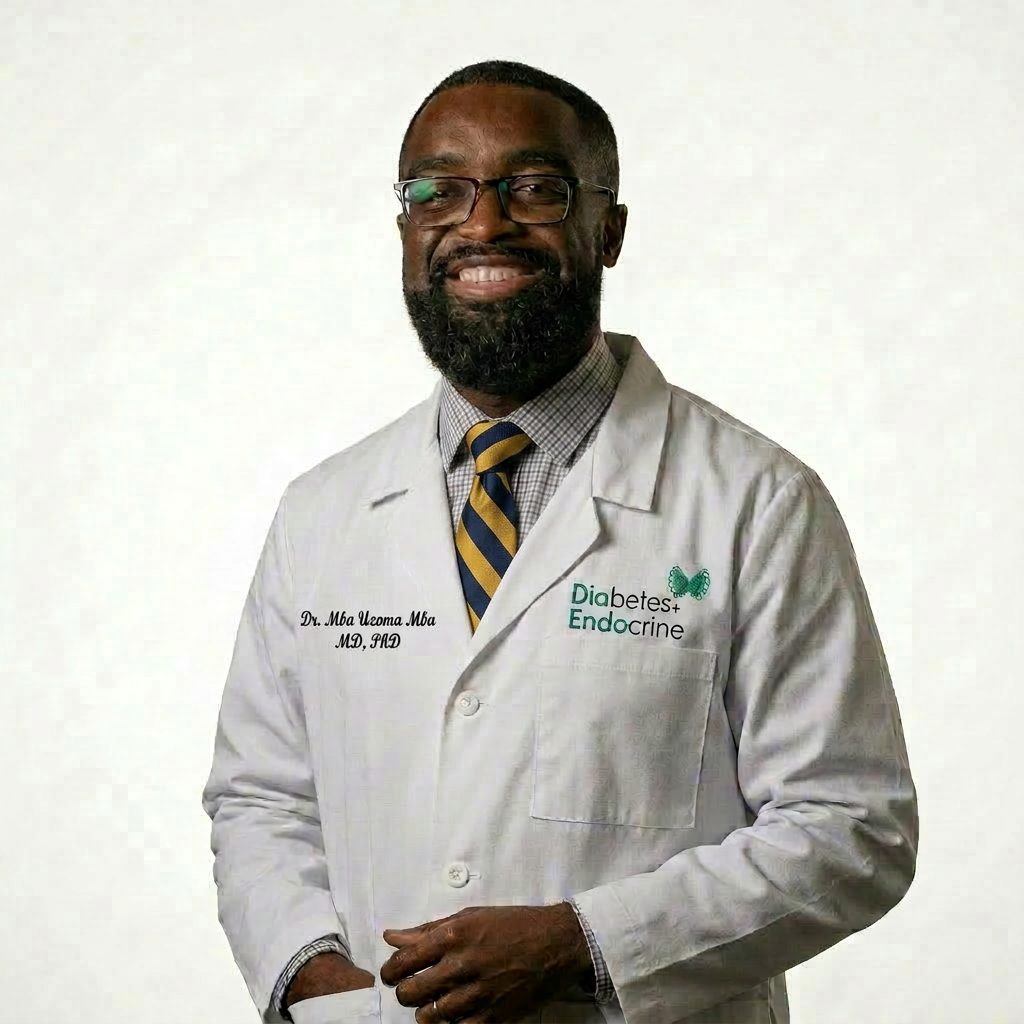
Mba Uzoma Mba, MD, PhD
Board-Certified Endocrinologist
Physician-scientist in endocrinology and metabolic health, held to the same evidence-first standard across the practice — clear answers, no hype, and no supplement sales.
Direct answers, before you even call.
Do I need an endocrinologist for low testosterone, or is my primary care doctor enough?
For a straightforward case, a primary care physician willing to do the full workup is entirely adequate — the discipline matters more than the specialty. An endocrinologist earns their place when the cause is unclear, when the pituitary may be involved, when other hormones are in play, or when a previous evaluation skipped LH and FSH. What a proper evaluation looks like →
Is testosterone therapy safe?
The largest randomized trial ever run on the question, TRAVERSE, found no increase in major adverse cardiac events over a median of about two years. It also found more atrial fibrillation, more pulmonary embolism and more acute kidney injury. Both halves of that are true, and the second half is usually left out. What TRAVERSE settled and what it did not →
My level is 340. Is that low?
It depends on which society your clinician trained under. The VA threshold is 264 ng/dL, the Endocrine Society and AUA sit near 300, and the EAU treats 346 and below as the diagnostic threshold. The same man is normal in one country and hypogonadal in another. He has not changed; the threshold has. Where the societies disagree →
Will testosterone affect my fertility?
Yes. Exogenous testosterone suppresses LH and FSH, and with them sperm production — in most men to severe oligospermia or azoospermia. Recovery is usual but not guaranteed and can take a year or more. If children are a possibility, settle this before the first dose. TRT and fertility →
Do you sell supplements or run a testosterone program?
No. We sell no supplements, accept no supplement advertising, and take no industry funding. There is no telehealth and no online prescribing. If the right answer for you is not testosterone, that is what you will be told. How this site is written →
Three offices across San Diego County.
La Jolla
9850 Genesee Ave, Suite 470
La Jolla, CA 92037
858-622-7200
Poway
15525 Pomerado Rd, Suite A1
Poway, CA 92064
858-622-7200
La Mesa
8851 Center Drive, Suite 404
La Mesa, CA 91942
619-463-1293
Mon – Fri, 8:45 AM – 5 PM. We welcome referrals from other physicians.
Ready for testosterone care that starts with a diagnosis?
The first step is a full endocrine evaluation, not a prescription. We see patients across San Diego County and welcome referrals from other physicians.